
Understanding Neurodiversity in Practice
Neurodiversity is often spoken about through definitions and labels.
But in the workplace, it shows up in much simpler ways.
How someone organises their work.
How they process information.
How they respond to pressure or communicate within a team.
In how they communicate.
Rather than looking at this as a deficit to be managed, it can be reframed in the workplace as differences to be understood.
Because if that understanding is not present, it can lead to misinterpretation, unnecessary pressure, and environments that unintentionally limit people rather than support them.
A Short Introduction to Neurodiversity at Work
To support this, I have created a short 6 minute video offering a simple and grounded introduction to neurodiversity in the workplace.
It explores what neurodiversity means in a practical work context, where misunderstandings often arise, and how small shifts in awareness can make a meaningful difference.
The CLEAR Approach
The CLEAR framework came from working with this in practice. From seeing the same patterns come up again and again.
People trying to explain how they work, and not being heard. Expectations that are not clear, but assumed. Situations where people are doing their best, but still feel misunderstood.
CLEAR brings structure to that.
Not more complexity, just more clarity.
Clarity in communication.
Clarity in expectations.
Clarity in how people are supported in a way that works.
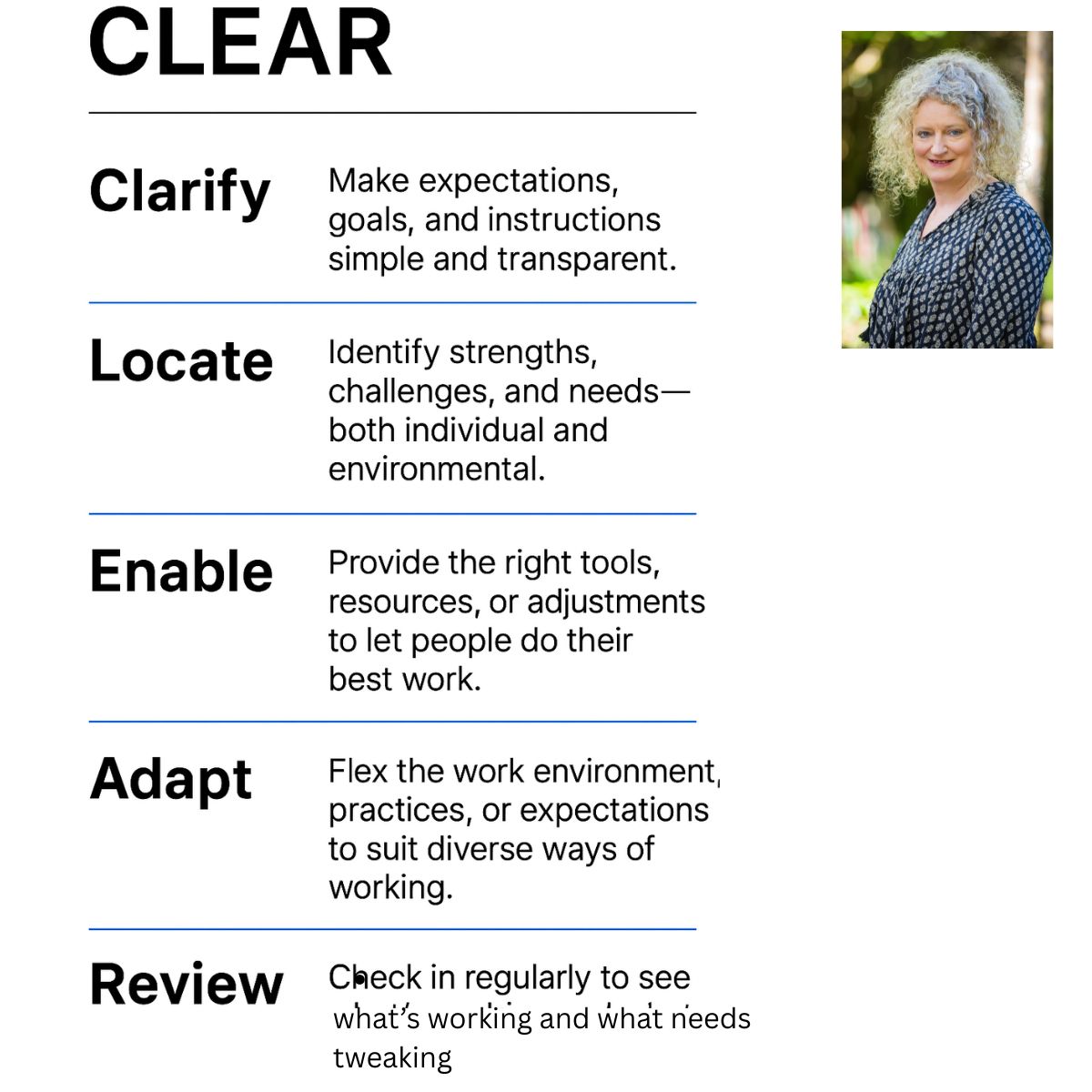
CLEAR FRAMEWORK
The tool is structured around the CLEAR approach, ensuring insights lead to action:
Clarify – Help employees and leaders understand executive function differences in clear, simple terms.
Locate – Identify how strengths and challenges show up in the workplace.
Enable – Give individuals the confidence and tools to communicate their needs and build on their strengths.
Adapt – Support managers and organisations to make practical adjustments that benefit everyone.
Review – Revisit insights regularly to track growth, refine strategies, and sustain inclusive cultures.
This framework ensures that the tool is not just reflective but also a catalyst for long-term change.
Benefits to Employees
Gain self-awareness about executive functioning and workplace needs.
Reduce stigma by reframing challenges as part of cognitive diversity.
Empower personal development and career pathways.
Benefits to Employers
Build a strengths-based framework for supporting neurodivergent employees.
Pinpoint barriers to inclusion, productivity, and engagement.
Create evidence-based strategies for training, support, and workplace design.
Enhance employer branding by committing to diversity, equity, and inclusion.

Neurodiversity@Work On Line Diagnostic Tool
Building Inclusive Workplaces Through Cognitive Diversity
What is the Neurodiversity@Work Tool?
The Neurodiversity@Work Tool is an innovative, reflective diagnostic designed to help organisations understand and support the diverse ways people think, learn, and process information. Unlike traditional assessments, this tool is not clinical instead, it provides a practical, workplace-focused framework for creating inclusive environments where neurodivergent employees can thrive.
Built on a scientific model of executive functioning developed by Dr. Thomas E. Brown, a leading expert in the field, the tool explores six key areas that affect workplace performance: organisation, focus, effort, emotion regulation, working memory, and self-monitoring.
Why This Matters
Up to 15% of the global population is neurodivergent including people with ADHD, autism and dyslexia. Yet many workplaces lack the awareness, tools, and data needed to fully support these talented individuals.
By using the Neurodiversity@Work Tool, organisations can uncover strengths, challenges, and practical solutions that drive engagement, productivity, and innovation.