
A Short Introduction to Neurodiversity at Work
Watch our short six-minute video for a grounded introduction to neurodiversity in the workplace.
The video explores what neurodiversity means in practice, where misunderstandings can arise and how small changes in awareness and communication can make a meaningful difference.
Neurodiversity in the Workplace Training
Understanding Difference. Improving Communication. Supporting Performance.
Neurodiversity in the workplace is about recognising that people think, process information, communicate and work in different ways.
These differences can influence how someone:
Organises and prioritises their work
Processes verbal or written information
Starts, manages or completes tasks
Responds to interruptions, uncertainty or change
Communicates within a team
Manages time, focus, energy and competing demands
Performs when under pressure
When these differences are not understood, behaviour can be misinterpreted. Someone may be viewed as disengaged, disorganised, difficult or lacking in confidence when they may be experiencing unclear expectations, cognitive overload or an unsuitable way of working.
Neurodiversity in the workplace training helps managers and teams look beyond behaviour, reduce unnecessary barriers and create clearer, more inclusive ways of working.
Practical Neurodiversity Training for the Workplace
Irish Health Hub provides practical and accessible neurodiversity training for business owners, managers, team leaders and employees.
The training moves beyond definitions and labels. It helps participants understand how neurodiversity may affect everyday workplace experiences, including communication, executive functioning, sensory needs, stress and performance.
The training is awareness-based and non-diagnostic. Managers are not expected to diagnose employees or make assumptions based on a particular condition. Instead, they learn how to have respectful conversations, clarify expectations and support people as individuals.
Participants leave with practical approaches they can apply within their own workplace.
What the Training Covers
The Neurodiversity in the Workplace programme can include:
What neurodiversity means in a practical workplace context
Common misconceptions and assumptions
Looking beyond behaviour to understand what may be happening
Executive functioning and workplace performance
Communication and information-processing differences
The effect of stress and the nervous system on performance
Psychological safety, trust and belonging
Practical workplace adjustments
Managing performance fairly and consistently
Inclusive leadership and team communication
The CLEAR approach to workplace support
Understanding Executive Functioning at Work
Executive functioning skills help us organise, begin and complete everyday activities. Differences in executive functioning can affect workplace performance, particularly when expectations are unclear or demands are competing.
The training introduces Dr Thomas E. Brown’s six executive-function clusters:
Activation: organising, prioritising and getting started
Focus: concentrating, maintaining attention and shifting between tasks
Effort: regulating alertness, sustaining effort and managing processing speed
Emotion: managing frustration and regulating emotional responses
Memory: using working memory and recalling information when needed
Action: monitoring and regulating behaviour
Understanding executive functioning gives managers a more useful starting point for conversations about work. It allows them to explore what is creating a difficulty and what practical support may improve performance.
Who the Training Is For
The training is suitable for:
Business owners
Managers and supervisors
HR professionals
Team leaders
Employees
Organisations beginning their neurodiversity and inclusion journey
No previous knowledge of neurodiversity is required.
Training Options
Neurodiversity at Work can be delivered online or in person and adapted to suit the needs of an organisation.
Options include:
Short introductory awareness sessions
Three-hour workplace workshops
Manager and leadership training
Team training
Organisation-specific sessions
Longer programmes exploring workplace culture, psychological safety, executive functioning and inclusion by design
Enquire About Neurodiversity Training
Would you like to help your managers and employees understand neurodiversity, communicate more clearly and create a more inclusive workplace?
Contact Irish Health Hub to discuss neurodiversity in the workplace training for your organisation.
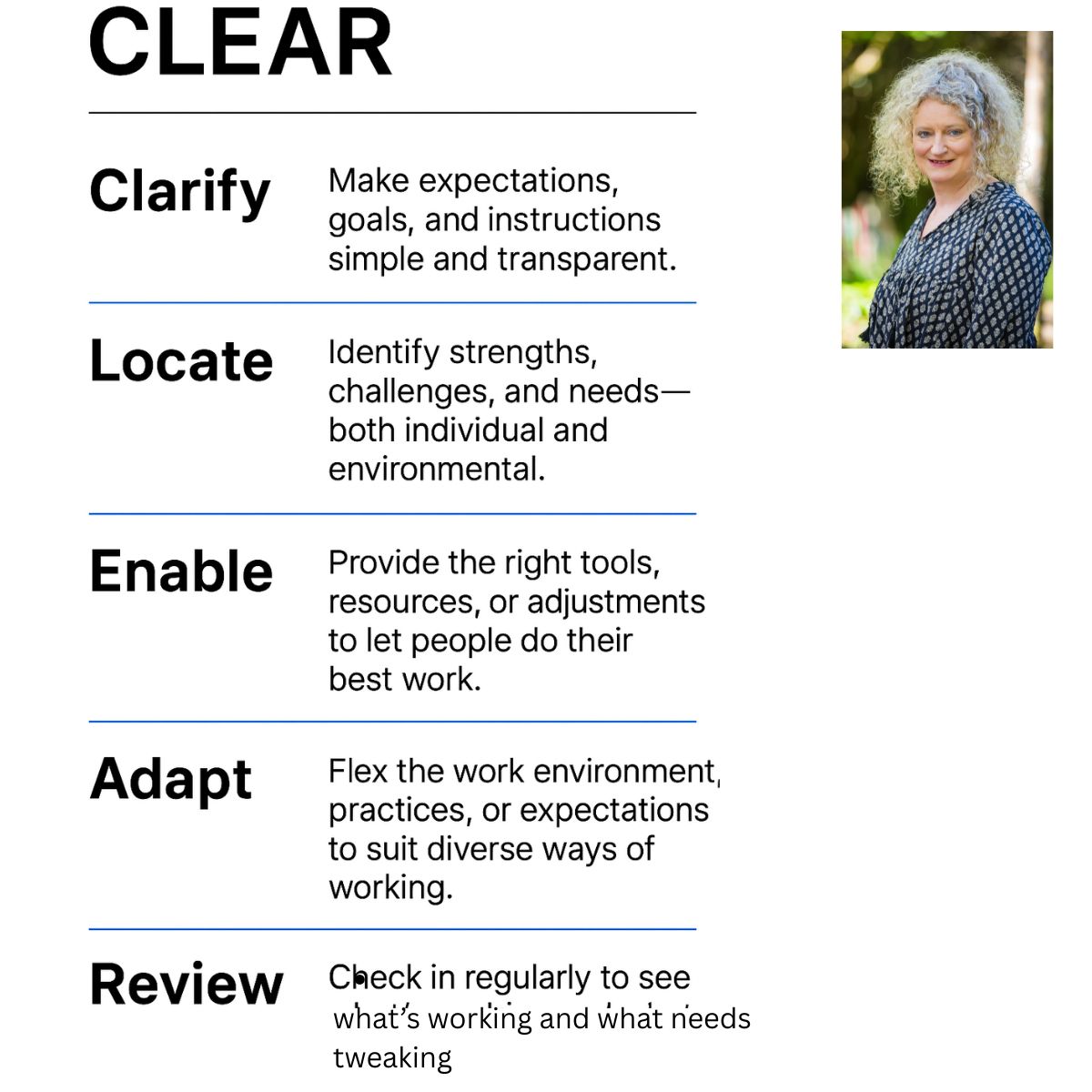
CLEAR FRAMEWORK
The tool is structured around the CLEAR approach, ensuring insights lead to action:
Clarify – Help employees and leaders understand executive function differences in clear, simple terms.
Locate – Identify how strengths and challenges show up in the workplace.
Enable – Give individuals the confidence and tools to communicate their needs and build on their strengths.
Adapt – Support managers and organisations to make practical adjustments that benefit everyone.
Review – Revisit insights regularly to track growth, refine strategies, and sustain inclusive cultures.
This framework ensures that the tool is not just reflective but also a catalyst for long-term change.
Benefits to Employees
Gain self-awareness about executive functioning and workplace needs.
Reduce stigma by reframing challenges as part of cognitive diversity.
Empower personal development and career pathways.
Benefits to Employers
Build a strengths-based framework for supporting neurodivergent employees.
Pinpoint barriers to inclusion, productivity, and engagement.
Create evidence-based strategies for training, support, and workplace design.
Enhance employer branding by committing to diversity, equity, and inclusion.
From a participant of a recent GRETB Neurodiversity at Work Training.

What is the Neurodiversity@Work Tool?
The Neurodiversity@Work Tool is an innovative, reflective diagnostic designed to help organisations understand and support the diverse ways people think, learn, and process information. Unlike traditional assessments, this tool is not clinical instead, it provides a practical, workplace-focused framework for creating inclusive environments where neurodivergent employees can thrive.
Built on a scientific model of executive functioning developed by Dr. Thomas E. Brown, a leading expert in the field, the tool explores six key areas that affect workplace performance: organisation, focus, effort, emotion regulation, working memory, and self-monitoring.
Why This Matters
Up to 15% of the global population is neurodivergent including people with ADHD, autism and dyslexia. Yet many workplaces lack the awareness, tools, and data needed to fully support these talented individuals.
By using the Neurodiversity@Work Tool, organisations can uncover strengths, challenges, and practical solutions that drive engagement, productivity, and innovation.